

Great Redwood Trail Agency
Master Plan
Overview
The Master Plan provides the foundation for the Great Redwood Trail. It sets guiding principles, design guidelines, policy recommendations, and priorities, helping answer key questions about how the trail should work and priorities for construction.
The Master Plan doesn’t design every foot of the trail or answer every question. Detailed, site-specific decisions will happen later, as individual projects move forward. But the plan does create a clear, shared starting point for future planning, design, and community input.
Master Plan Overview
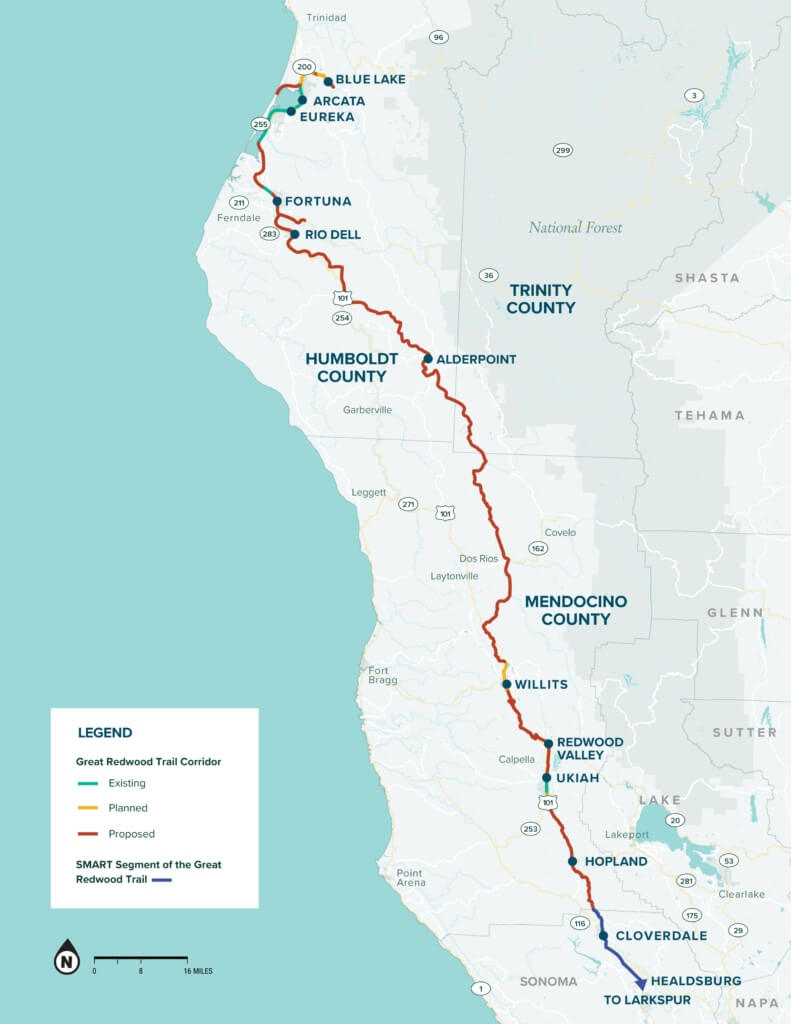
The Great Redwood Trail Master Plan will be a roadmap for planning, constructing, and managing the future Great Redwood Trail. The master plan is being informed by a robust Community Engagement Plan that is capturing community desires, concerns and ideas to develop the Great Redwood Trail. Once complete, the master plan will serve as a guiding document to address issues including but not limited to trail user experience, trail design, operations and maintenance, habitat restoration, project priorities, funding, and management of the trail. The master plan covers Mendocino, Trinity and Humboldt counties. The Southern Segment of the Great Redwood Trail in Sonoma and Marin Counties will be planned, constructed, and operated by Sonoma-Marin Area Rail Transit District (SMART) with Larkspur at its southern terminus. The final connection between Larkspur and the Golden Gate Bridge may be planned, constructed, and operated by others.
Vision for the Trail
The Great Redwood Trail (GRT) will be a world-class regional rail-trail system that connects remote places in northern California with the bustling San Francisco Bay Area and Humboldt Bay communities. The GRT will offer unique, memorable trail experiences for people who live nearby or visit from far away. The GRT will generate new trail-oriented development and economic opportunities. The trail will be designed and managed to enhance the surrounding natural environment, respect neighboring properties, and offer safe and equitable access for a wide range of users, including hikers, equestrians, cyclists, runners, wheelchair users, and others. The Great Redwood Trail Agency (GRTA) will work collaboratively with California Native American tribes, residents, landowners, businesses, community-based organizations, and government partners to solve problems and oversee this incredible trail network.
Study Area
Vision for the Trail
The Great Redwood Trail (GRT) will be a world-class regional rail-trail system that connects remote places in northern California with the bustling San Francisco Bay Area and Humboldt Bay communities. The GRT will offer unique, memorable trail experiences for people who live nearby or visit from far away. The GRT will generate new trail-oriented development and economic opportunities. The trail will be designed and managed to enhance the surrounding natural environment, respect neighboring properties, and offer safe and equitable access for a wide range of users, including hikers, equestrians, cyclists, runners, wheelchair users, and others. The Great Redwood Trail Agency (GRTA) will work collaboratively with California Native American tribes, residents, landowners, businesses, community-based organizations, and government partners to solve problems and oversee this incredible trail network.
The Master Plan

The Public

Prioritize Projects
Vision For The Trail
Operations & Maintenance

For Community Concerns
How Can I View The Master Plan?
Chapters
Appendices
Frequently Asked Questions
Design & Use
Operation & Maintenance
Timeline & Implementation
How will the Great Redwood Trail support existing communities and businesses?
The Great Redwood Trail will create a transformational economic engine. The immense scale and scenic beauty of the completed trail will create new recreational experiences that become a destination for all of California and beyond. The benefits of the trail will expand into the communities along the corridor that support trail users with services. The mutual relationship between the Great Redwood Trail and the trail towns along it can create sustained economic benefits for generations.
As part of the Master Plan, an Economic Benefit Analysis was completed for the proposed trail in Humboldt, Trinity, and Mendocino Counties. In total, the fully completed trail and associated impacts are estimated to generate over $100,000,000 in annual benefits. These benefits include:
- Recreation, tourism, and retail benefits from visitor spending on lodging, goods, and services.
- Transportation benefits of fewer vehicular miles traveled, including lower roadway maintenance costs and increased individual savings.
- Health benefits from expanded recreation opportunities and associated reduction in health care costs.
How will the railroad and the trail interact?
From Willits north to Humboldt Bay, the rail corridor has been “railbanked,” allowing the Great Redwood Trail to be built as a rail-to-trail, where the trail will be located within the historic rail alignment. The right of way will be maintained in an unbroken fashion to protect the long-term status of the trail under federal law. From Willits south to the Sonoma County border, the interaction between the railroad and the trail is still being determined. The majority of the Great Redwood Trail in Sonoma and Marin County will be rail-with-trail operated by SMART. To learn more about GRTA railbanking efforts, visit our webpage at: https://thegreatredwoodtrail.org/railbanking/
Who will be able to use the Great Redwood Trail?
The Great Redwood Trail will be a multi-use trail with sections open to walking, biking, equestrians, and other means of mobility, as well as opportunities for long-distance hiking, cycling, and riding. The types of allowed trail uses will vary by section depending on the environment and community input during the Master Planning process, among other factors.
What will the Great Redwood Trail’s surface be?
The Great Redwood Trail will have a variety of trail surface types over its 231 miles, including paved multi-use, crushed-stone multi-use, and backcountry natural earth surface. Paved multi-use trails consist of concrete or asphalt and will be located near cities, towns, and areas with high use, while backcountry trails are constructed using natural earth material and will be located in the most rural sections of the trail, including the Eel River Canyon. The extent and locations proposed for each trail surface type will be included in the Master Planning process and will be informed by community input.
Will the Great Redwood Trail be Accessible?
Sections of the Great Redwood Trail will be accessible, including certain access points and amenities. The opportunities for accessible trail sections will be identified as part of the Master Planning process and informed by community input, and in compliance with any applicable law.
What types of amenities will be along the trail?
Amenities along the trail may include trailheads, parking, restrooms, water access, kayak launches, campgrounds, seating, viewpoints, public art, and more. Opportunities and ideas for trail amenities will be identified as part of the Master Planning process and informed by community input.
Who will own, manage, and maintain the Great Redwood Trail?
The Great Redwood Trail will be managed and maintained by a variety of regional and local public agencies and recreation-oriented non-profits. Specific agencies and the length of trail each will manage and maintain will be identified as part of the Master Planning process.
How will private property be protected?
Adjacent property owners’ desires for privacy and protection along the Great Redwood Trail will vary by landowner and land use. The project team will work with adjacent landowners to understand their concerns and, as applicable, identify practical design solutions for the trail corridor as part of the Master Planning process. Specific design solutions for each trail section will not be determined until after the Master Plan is completed and the trail section reaches the Design Phase.
If you are a private landowner along the planned Great Redwood Trail alignment, we want to hear from you. Contact us directly using the contacts listed form at https://thegreatredwoodtrail.org/contact-us/ or leave a voicemail at (707) 463-3280. You must leave a voicemail to receive a response.
How will personal safety and security be addressed?
The Master Plan will identify trail design features, policies, and operations to address personal safety and security issues. The Project Team will coordinate with local law enforcement and fire departments to inform safety and emergency procedures. Some ideas currently include law enforcement patrols, emergency call boxes, fencing, and other access control features.
How will fire hazards be addressed?
The Master Plan will include trail design guidelines that incorporate best practices for minimizing fire risks. The Project Team will coordinate with local fire departments to inform fire safety along the trail. The Master Plan will also identify opportunities for the Great Redwood Trail to serve as a potential fire break and/or assist firefighters in accessing fire prone wilderness areas.
How will homelessness and encampments be addressed?
The Master Plan will include a comprehensive strategy that outlines the legal and practical tools available to prevent or minimize camping in undesignated locations. Collaborating with housing and social service agencies to address this issue has been successful on this and other rail-trails trails in California. “Lessons learned” will be included in design guidelines and the Great Redwood Trail’s operations and maintenance plan.
How will the Great Redwood Trail be funded?
The Master Plan will identify funding sources to support development of new trail segments, along with funding options for maintenance of existing and future trail segments. Funding may come from a variety of public and private sources including appropriations from the legislature and grants.
When will it be completed?
Though the Great Redwood Trail is a long-term project, portions of the trail already exist and can be used today. This includes Ukiah Rail-Trail, Eureka Waterfront Trail, Humboldt Bay Trail, Arcata Rail-with-Trail, and Annie & Mary Trail. An additional 40 miles of trail is currently in the planning or construction stage, in Willits, the Eel River Canyon, and Humboldt County. Future sections of the trail will be prioritized and funded for planning and construction as the Master Plan is completed and beyond.
What sections will be built first?
A prioritization process will rank the order and priority for constructing the Great Redwood Trail, segment by segment. This trail prioritization will be informed by community and agency priorities, anticipated trail demand, and the feasibility and cost of each section. The full trail prioritization process will be developed as part of the Master Plan.